Mapping solid-fuel cooking and attributable under-five respiratory mortality across 98 countries
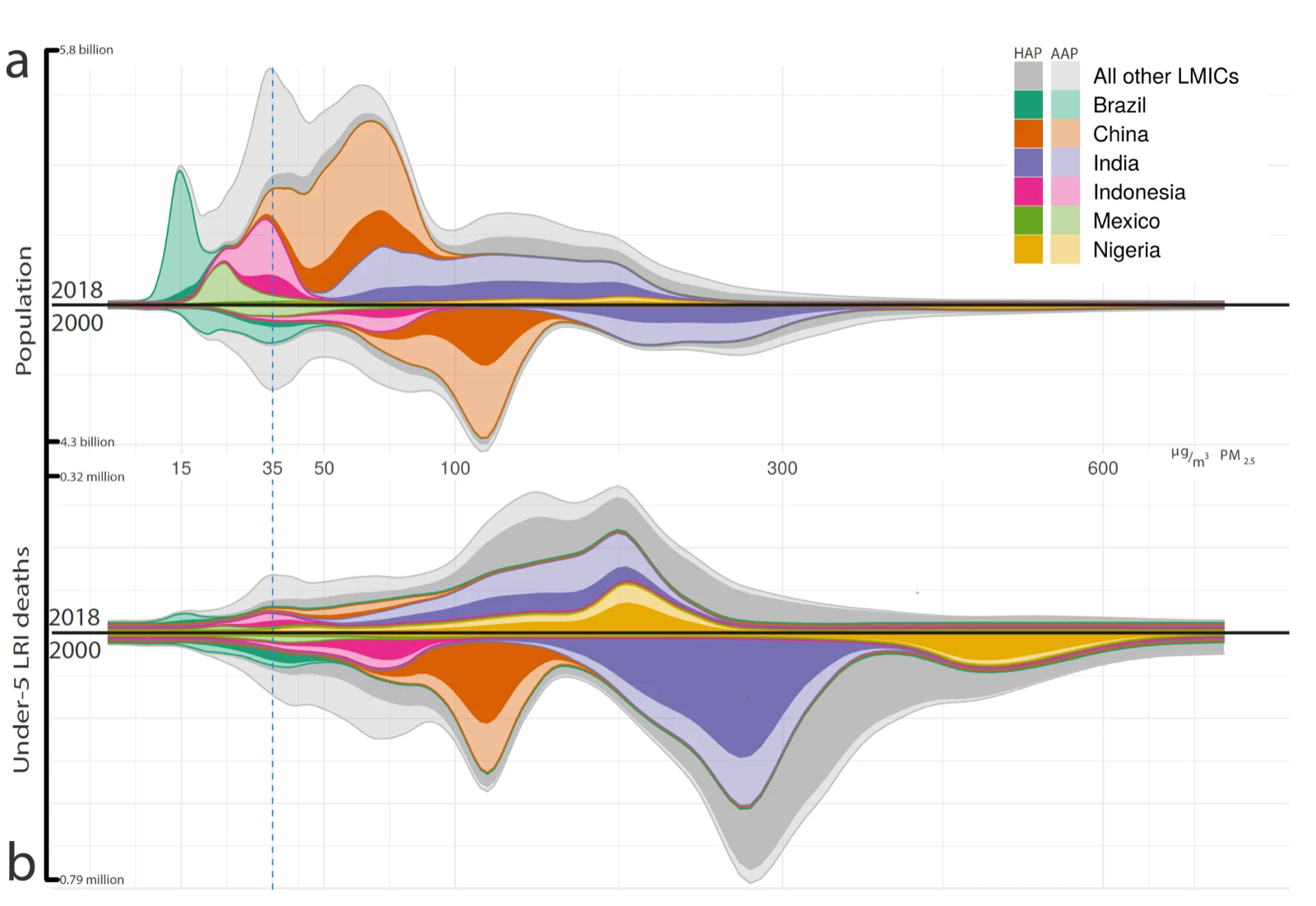
This analysis estimated solid-fuel cooking prevalence at 5 km resolution across 98 low- and middle-income countries from 2000–2018. Those estimates fed household-air-pollution exposure and attributable under-five respiratory mortality estimates, with forecasts to the 2030 clean-cooking target.
National averages
Progress toward the clean-cooking target, SDG 7.1, is commonly reported at national scale. Those averages cannot show where solid-fuel use is concentrated within a country or how exposure differs between districts. Estimating prevalence at 5 km resolution made those within-country gradients available for exposure, burden, and 2030 trajectory estimates.
Model pipeline
A model-based-geostatistics (MBG) pipeline that turns millions of scattered survey responses into continuous 5 km surfaces:
- Assemble: 2.1 million household observations from 663 surveys, geo-located and collapsed to cluster-level solid-fuel-use rates, joined to dozens of satellite/geospatial covariates (nightlights, travel time, climate, land cover, population, ambient PM2.5).
- Stack: a constrained ensemble of machine-learning submodels (GAM, gradient-boosted trees, penalized regression) fit with cross-validation. Their predictions become the mean surface.
- Geostatistics: a Bayesian hierarchical model adds a spatial Gaussian process (SPDE) and country and sub-national random effects, fit with
R-INLA. It borrows strength across space to estimate, with uncertainty, even where surveys are sparse. - Calibrate & aggregate: raked to national GBD estimates, aggregated to admin 0/1/2.
- Forecast & burden: annualized-rate-of-change projections to 2030 vs. SDG 7.1, combined with ambient PM2.5 and relative-risk curves to estimate attributable under-five respiratory mortality.
Mapped results
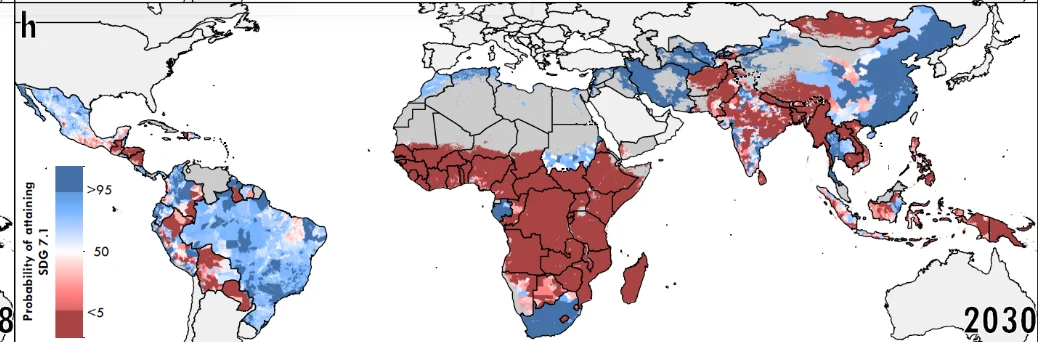
In 2018, 593 million people lived in districts where solid-fuel use exceeded 95%. Only five of the 98 countries had a greater than 95% probability of reaching universal clean-cooking access in every district by 2030. The burden model attributed 205,000 under-five deaths from lower respiratory infections (95% UI 147,000–257,000) to household air pollution in 2018.
My role
- First author, responsible for the full analysis from survey extraction through the modeled surfaces, forecasts, and burden estimates.
- The stacked-ensemble + Bayesian geostatistical model and its covariate/validation design.
- The 2030 SDG forecasts and the exposure-to-mortality burden chain.
- The paper, published in Lancet Global Health.
Published outputs
The published outputs include annual 5 km surfaces for 2000–2018, summaries at three administrative levels, 2030 clean-cooking projections, and attributable under-five respiratory mortality estimates.